Salvaguardas de DPI en la 80.ª Asamblea General de la ONU

From Commitment to Ownership: Advancing Digital Public Infrastructure with Safeguards

As digital public infrastructure (DPI) increasingly shapes how people access essential services, governments and partners gathered during the High-Level Week of the 81st United Nations General Assembly to focus on a critical next step: turning commitments on safeguards into implementation at scale.
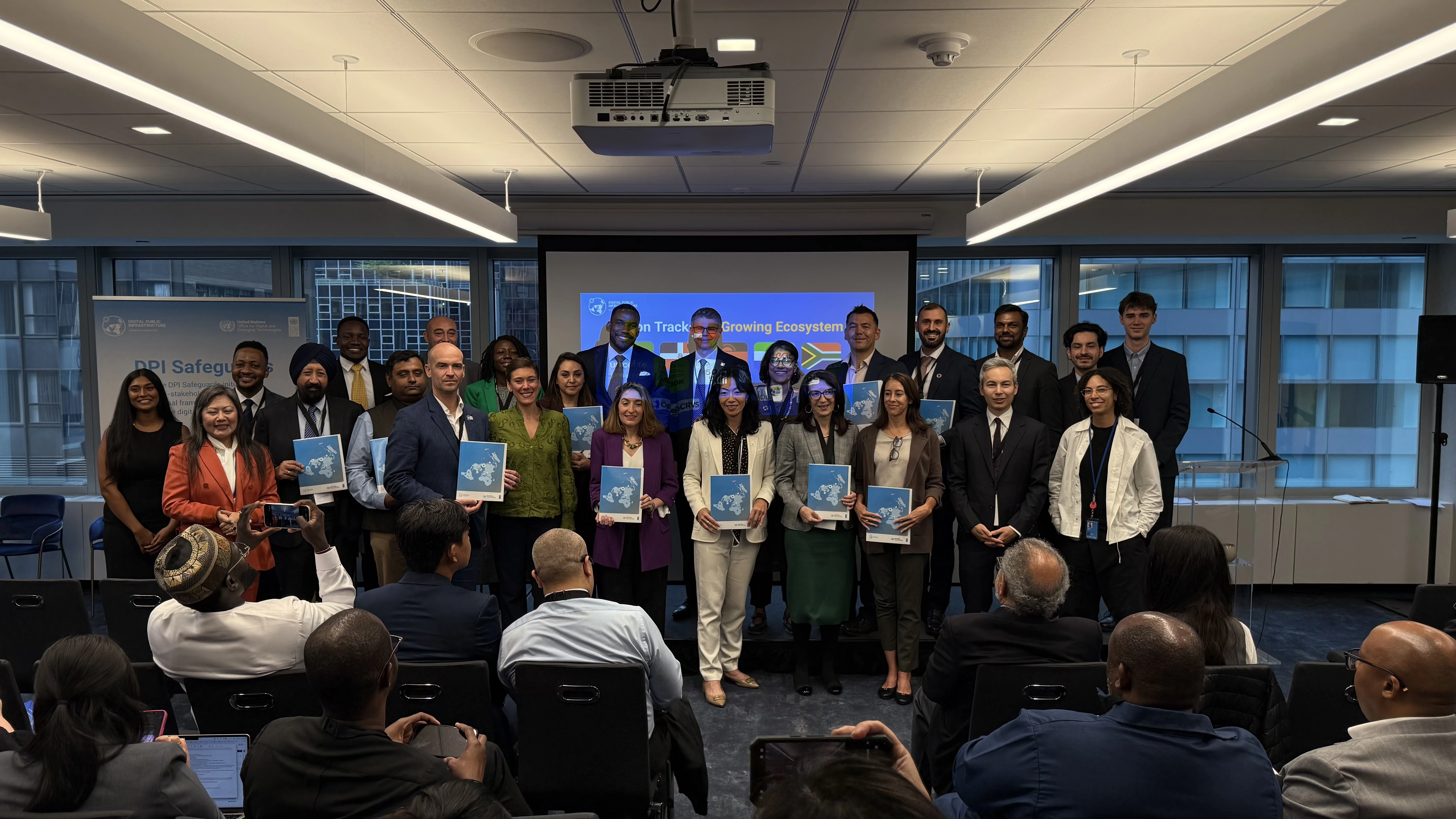
From Commitment to Ownership: Advancing DPI with Safeguards was convened by the United Nations Office for Digital and Emerging Technologies (UN ODET) and the United Nations Development Programme (UNDP), co-leads of the DPI Safeguards Initiative, in partnership with Co-Develop and the Center for Financial Inclusion.

The event brought together senior government officials, international organizations, development partners and civil society to share progress, examine practical challenges and identify priorities for ensuring that digital public infrastructure is safe, inclusive and accountable as it expands. Following the development of the Universal DPI Safeguards Framework, the focus is increasingly on what implementation looks like in practice, how countries through an ecosystem approach can be supported to embed safeguards from the outset, and how progress can be tracked and promoted.
A clear demonstration of progress came from Malawi, which has moved from high-level principle to rigorous institutional alignment. With over 15.5 million people registered in its national registry—more than 80 percent of those eligible and 53 percent women—the country’s National Registration Bureau mapped its own practices directly against the Universal DPI Safeguards Framework to uncover gaps and guide national legal reforms. Building on its Data Protection Act of 2024, Malawi is introducing upfront risk assessments for public AI, barring mass biometric surveillance without lawful basis, and expanding safeguards from identity into payments and data exchange—all recorded transparently on the DPI Safeguards Action Tracker.

For Malawi, digital public infrastructure is not simply an information technology problem—it is a national compact of trust between the state and its people. An infrastructure that a woman is afraid to use is not public infrastructure. We urge partners to finance safeguards as core infrastructure—integrating accessibility, cybersecurity, and remedies from the start, not as an afterthought after deployment.

— H.E. Dr. Shadrick Namalomba, Minister of Information and Communications Technology, Malawi

In building MyMzansi, our experience taught us to collect less data to connect more, ensuring information is strictly linked to purpose. More importantly, redress must be real. Having a complaints button in an app is meaningless unless there is genuine institutional capacity and departmental process on the other side to resolve the failure. A trustworthy system is ultimately proven by how safely and effectively it protects citizens when things go wrong.

— Melvyn Lubega, Head of the Digital Services Unit, South Africa

South Africa similarly reflected on operationalizing safeguards within its unified public platform, MyMzansi, where early design choices are anchoring data collection strictly to purpose rather than creating monolithic government databases. Through joint leadership between the Presidency and National Treasury, the country is embedding institutional recourse mechanisms and partnering with civil society to ensure safeguards deliver tangible, trusted redress whenever systems fail citizens on the ground.
The Initiative entered its second phase in early 2026, shifting focus to mobilizing the wider ecosystem to adopt and leverage the Universal DPI Safeguards Framework while providing the targeted support governments need to implement safeguards through an enablers collective. This phase advances adoption transparently through the Action Tracker and delivers progress at scale via key implementation mechanisms, including the DPI Safeguards Accelerator and an expanding network of partners.

Making Commitments Visible

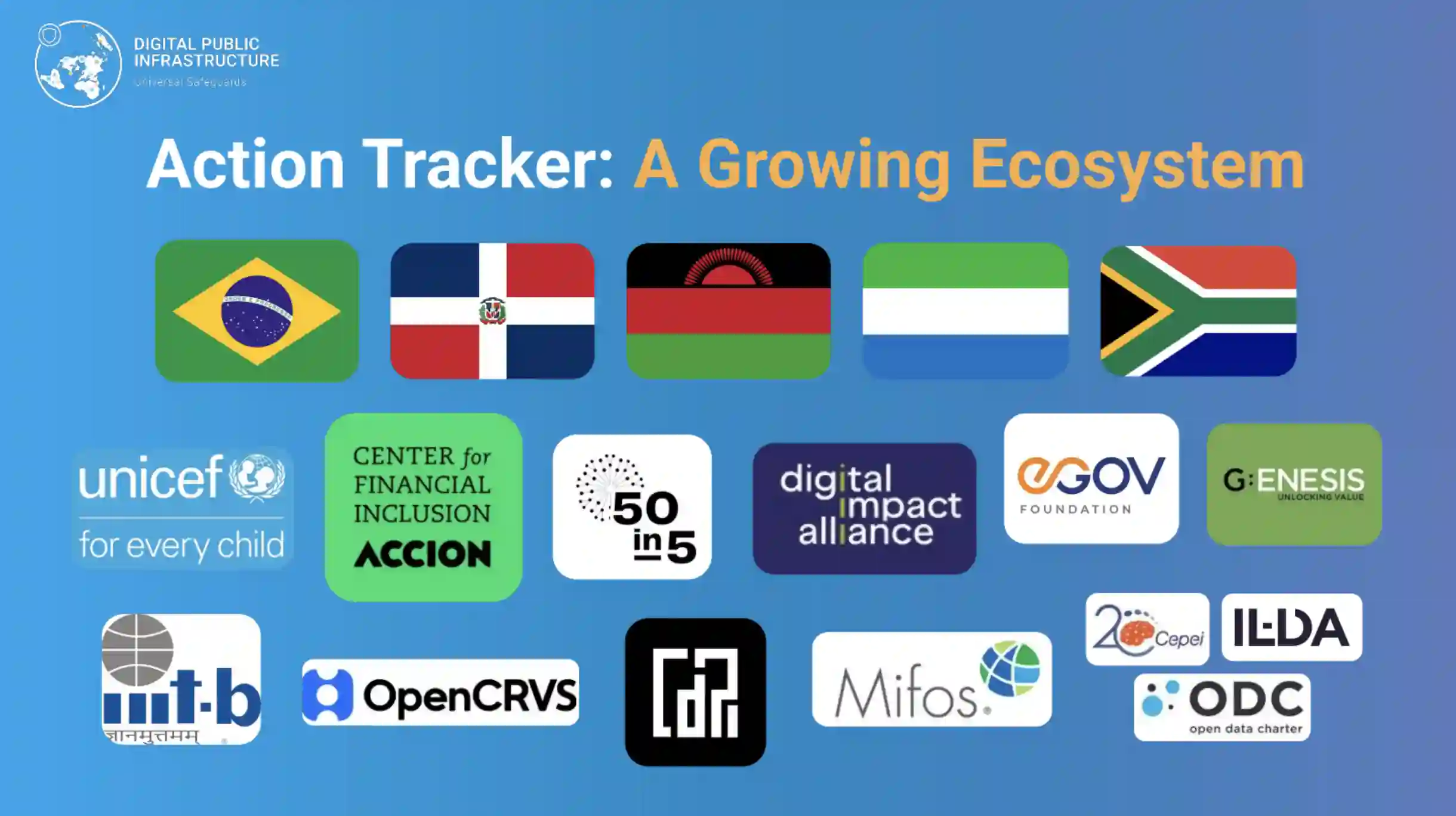
The event launched the public DPI Safeguards Action Tracker, an open accountability mechanism designed to make commitments from governments and partners—as well as tangible progress against those commitments—fully transparent.  

The Tracker provides a direct line of sight from high-level endorsement to technical execution, sustaining focus on whether safeguards are truly being embedded into national policies, institutional workflows, and software codebases.  

Country and partner perspectives brought that transition to life. The Dominican Republic formally endorsed the Framework, outlining its roadmap to integrate safeguards across national interoperability, digital identity, and the Carpeta Ciudadana citizen portal. Alongside this were commitments and priorities highlighted by Sierra Leone and potential endorsements from Tanzania and Senegal.

Endorsing the Universal DPI Safeguards Framework builds directly on our national digital readiness assessments and action plans. Safeguards are not an optional addition to digital transformation; they are part of its foundation, essential to ensuring our national interoperability, digital identity, and citizen-facing services remain integrated, secure, and centered on people’s rights.

— H.E. Sigmund Freund, Minister of Public Administration, Dominican Republic

In Sierra Leone, we are building digital public infrastructure that serves our people across their entire life cycle—from birth registration to economic participation. Aligning with the Universal DPI Safeguards Framework gives us the standard to ensure these systems protect privacy, foster inclusion, and remain accountable to our citizens as they grow.

— H.E. Salima Bah, Minister of Communication, Technology and Innovation, Sierra Leone

Global and regional partners reinforced these government actions with tangible commitments:

The Digital Public Goods Alliance (DPGA) & 50-in-5 Campaign

Committed to doubling down on South-South peer-learning exchanges across 14 member countries and updating DPG standards to protect against cybersecurity vulnerabilities and AI-driven risks.

The Mifos Initiative (for the DPG Collaborative for Digital Public Services)

Pledged to embed safeguards across an end-to-end buyer’s journey, product features, and training curriculums for local system integrators.

The Latin American DPI Consortium

 Committed to deploying a practical rapid risk-assessment tool and Spanish- and Portuguese-language repositories to build technical capacity and empower civil society oversight across the region.
Underscoring the urgent global demand for actionable support, the DPI Safeguards Accelerator received 279 applications across 108 countries. Crucially, 214 of those submissions represent systems already active on the ground, demonstrating that governments and partners are not starting from scratch—they are actively seeking practical frameworks, technical tools, and peer cohorts to retrofit, reinforce, and embed safeguards directly into live, operational digital public infrastructure.

To turn this unprecedented demand into sustained impact, the Initiative is channeling resources through targeted catalytic funding and partnership models. Through the DPI Safeguards Accelerator Investment Opportunity, investors, philanthropic leaders, and development finance institutions can directly resource the institutions, technical assistance, and cross-border learning mechanisms that participating teams need to translate safeguards commitments into lasting institutional capability and trusted digital systems at scale.

Safeguards in Frontier Themes

A parallel session on national harmonization and cross-border interoperability examined how countries can connect foundational systems—such as digital identity, data exchange, and payments—across borders without sacrificing national sovereignty or centralizing sensitive data.

Rwanda’s experience, presented by Minister Paula Ingabire, highlighted how investments in trusted foundational identity, purpose-built institutions, and single-window service delivery through Irembo established the essential domestic baseline for regional cross-border initiatives, including seamless peer-to-peer mobile payments across East African borders. These domestic rails demonstrate that interoperability can only succeed when strong institutional oversight and citizen trust are architected at home before connecting across jurisdictions.
Mariana Brito, Program Director of Gov.br, spotlighted the Brazil–Uruguay bilateral integration, which enables citizens to authenticate across borders to access more than 300 government services without merging national registries or compromising data sovereignty. She emphasized that applying federated data architectures to regional challenges—such as environmental monitoring in the Amazon Basin through Brazil's Rural Environmental Registry (CAR) and the expansion of the ID-LAC initiative across 12 countries—relies fundamentally on safeguards: strict purpose limitation, data minimization, open standards to prevent vendor lock-in, and granular access controls for sensitive territorial and personal data. 
Panelists emphasized that cross-border integration depends on institutional trust, mutual recognition, and treaties rather than technology alone. Today, open-source digital public goods and verifiable credentials enable seamless cross-border economic coordination while preserving full domestic data sovereignty. Crucially, participants underscored that regional frameworks like the AfCFTA Digital Trade Protocol require deep spectrum coordination, fair connectivity pricing, and regulatory alignment so that cross-border expansion does not widen existing digital divides or leave critical infrastructure exposed to uneven security standards. 
Running in tandem, a dedicated DPI × AI workshop, convened by CDPI, DIAL, UNICEF, and UNDP’s AI Trust and Safety team, examined how to govern these technologies as they deploy across health, social protection, agriculture, financial inclusion, and emergency response. Across both breakout tracks, a central consensus emerged: whether systems are connecting across borders or powering automated decisions, advanced digital transformation is only as viable as the underlying trust in its infrastructure. As artificial intelligence becomes embedded into public administration, trusted DPI foundations, meaningful human oversight, inclusive access, and actionable routes for citizen redress become indispensable—with practical insights from the session directly informing the next iteration of the Universal DPI Safeguards Framework. 

Moving Forward: From Digital ID to Trusted Digital Public Infrastructure

The closing session introduced UNDP’s work to integrate DPI safeguards into its Digital ID Governance Framework and Assessment. Sarah Lister, UNDP’s Head of Governance, explained how the framework helps governments put inclusion, privacy, transparency, accountability and redress into practice as they develop digital identity systems. Mr. Jonathan Reid, Minister of Innovation, Industry, Science and Technology of Barbados, shared how the assessment of Trident ID is informing decisions on governance, service integration and inclusion as the country plans its next steps. The session illustrated how the framework can help governments move from safeguards principles to practical decisions that strengthen trust and improve access to services.
The event directly addressed the financing gap underpinning long-term safeguards adoption, connecting the agenda with the commitments of the Global Digital Compact to ensure that public digital rails foster open, resilient, and human-rights-respecting digital transformations.

Member States must own this agenda fully as we connect national progress to global commitments. Advancing implementation means showing what safeguards look like on the ground. Safeguards are never an obstacle to innovation; they are the prerequisite that makes digital transformation sustainable, resilient, and trusted.

— Amandeep Singh Gill, United Nations Under-Secretary-General and Special Envoy for Digital and Emerging Technologies

What will it take to turn this momentum into action at scale? Three things stand out: commitment, capacity, and capital. Every new endorsement strengthens ownership, while the Accelerator builds capacity closer to where the work happens. Crucially, safeguards must be built into how digital transformation is financed from the outset—we cannot ignore the financing of DPI safeguards in the rush to fund new technologies.

— Marcos Neto, Assistant Secretary-General and Director, Bureau for Policy and Programme Support, UNDP

The conversation on resourcing continued in closed-door sessions: a philanthropic dialogue co-led with the Centre for Exponential Change (C4EC), exploring how the networks, institutional capabilities, and community relationships that build trust can become shared infrastructure and investment for development; and a dedicated development finance roundtable convening ministries, DPI practitioners, the World Bank, and multilateral partners to address whole-of-government coordination, total cost of ownership, and agile procurement. Insights and recommendations generated across these sessions will feed directly into the newly launched multi-stakeholder Technical Working Groups on Financing DPI with Safeguards. These aim to help structure national budget allocations, inform donor practices, and guide sustainable lifecycle financing over the coming year.

Join the DPI Safeguards Community

Help shape the future of safe, inclusive, and trusted digital public infrastructure. Adopt safeguards in your digital transformation journey or invest in the initiative.

Universal DPI Safeguards: Guardrails to Accelerate Progress on the SDGs

80th Session of the UN General Assembly (UNGA 80)

Overview

During the High-Level Week of the 80th UN General Assembly and as part of the first UN Digital Cooperation Day, the DPI Safeguards initiative convened more than 200 voices from across the digital public infrastructure (DPI) ecosystem to showcase progress on the Universal DPI Safeguards Framework. From country showcases to the announcement of new tools and research grants, the discussions highlighted the importance of DPI safeguards as the foundation of equitable access for all and brought to the fore actionable insights to advance impactful DPI adoption and implementation.

Background

The Global Digital Compact reinforces the political and financial backing for DPI, with UN Member States committing to scale up investments, establish safeguards, and share best practices.

Country Adoption Progress & New Assets Launch

11:00 - 13:00

Session Agenda

Opening Segment

11:05 – 11:17 hours (12’)

Mr. Robert Opp
Chief Digital Officer, Digital AI and Innovation Hub, UNDP
Button Text
Mr. Alex Wong
Senior Advisor at Office of the ITU Secretary General
Button Text
Moderator
Moritz Fromageot
Associate Expert, UN Office for Digital and Emerging Technologies
Button Text

Country Adoption and Progress

11:17 – 11:57 hours (40’)

Safeguards are the heartbeat of DPI, and are paramount for ensuring that digital transformation at scale empowers and delivers benefits for everyone. This message resonated in country showcases from Brazil, India, Malawi, Nigeria, Rwanda and South Africa, where emerging lessons and insights have been demonstrating how inclusive design and multi-stakeholder collaboration can unlock creative solutions that are adaptable to local contexts. During the event, Brazil and South Africa committed to adopting the Universal DPI Safeguards Framework (view theirs and other commitment letters here).

Mr. Auduto Modesto
Deputy Minister of Management and Innovation and Public Services, Brazil
Mr. Sudhakar Dalela
Vice Minister  for Multilateral
Economic Relations, India
Mr. Mondli Gungubele
Deputy Minister of Communications
and Digital Technologies, South Africa.
Moderator
Ms. Keyzom Ngodup Massally
Head of Digital and AI Programmes, UNDP
Ms. Elizabeth Atori
Program Manager at the Initiative for Social and Economic Rights (ISER), Uganda
Ms. Liv Marte Nordhaug
Chief Executive Officer, Digital Public Goods Alliance Secretariat
Mr. Antoine Sebera
Chief Executive Officer (CEO) at Rwanda Information Society Authority (RISA)
Engr. (Dr.) Abisoye Coker-Odusote
Director-General and Chief Executive Officer of the National Identity Management Commission (NIMC)
Moderator
Ms. Keyzom Ngodup Massally
Head of Digital and AI Programmes, UNDP

Launching New Global Assets

12:00 – 12:19 hours (20’)

The milestone event marked one year since the public release of the Universal DPI Safeguards Framework, which is a public asset that offers practical, rights-based guidance to address the governance, design and deployment of inclusive and safe DPI. The second iteration of the Universal DPI Safeguards Framework (2.0) was developed over the past year, drawing on the learnings, experiences and feedback from consultations with various actors across the ecosystem.

Mr. Amandeep Singh Gill
Under-Secretary-General and Special Envoy for
Digital and Emerging Technologies
Ms. Elizabeth Garber
Founder of Humanitech and Strategy Director at the OpenID Foundation
Mr. Edward Cable
President/CEO & Co-Founder, Mifos Initiative
Ms. Tobi Kasali
Senior Analyst, United Nations Office for Digital and Emerging Technologies
Mr. Francesco Stabilito
Project Manager, United Nations Office for Digital and Emerging Technologies
Moderator
Mr. Moritz Fromageot
Associate Expert, United Nations Office for Digital and Emerging Technologies

Investing in Safety & Inclusion:
Scaling DPI to accelerate progress on the SDGs  (Panel)

12:30 – 13:00 hours (30’)

Safeguards are the foundation of equitable access, crucial for breaking down barriers like language, literacy and socioeconomic status to ensure that marginalized groups - such as rural farmers, Indigenous communities and women - are fully included in DPI benefits. This was the common message that emerged from a multistakeholder panel on investing in DPI, which emphasized how investing in safeguards can deliver efficiency gains by reducing costs and administrative friction for governments and citizens alike. 

Mr. Sangbu Kim
VP for Digital, World Bank Group
Mr. Sanjay Jain
Director, Digital Public Infrastructure,
Gates Foundation
Ms. Laura Bingham
 Executive Director at the Institute for Law,
Innovation & Technology 
Ms Heidy Rombouts
Director General for Development Cooperation and Humanitarian Aid, Belgian Ministry of Foreign Affairs
Mr. Melvyn Luberga
Lead of the Digital Services Unit in the Presidency, South Africa
Moderator
Ms. Raja Chandrasekharan
DPI Safeguards Lead, UNDP

Images

DPI Insights Community - The Need for Evidence and Foresight

14:00 - 15:00

In line with the growing demand for research and evidence to guide safe and inclusive DPI adoption, the event concluded with the announcement of eight new research grants of up to USD 40,000 each, awarded by the DPI Insights Community. This community is made up of a global network of researchers, academics, private sector actors and policymakers and is led by the Center for Financial Inclusion. These grants were awarded to six finalists from diverse country contexts who are pioneering research in the fields of consumer trust and protection, governance, financial systems and inclusion, equity, and empowerment, among others.

Panel

14:00 – 14:45 hours (45’)

Mr. Max Cuvellier
Head of Mobile for Development, GSMA
Button Text
Mr. Matthew McNaughton
Fellow, Africa Program, Carnegie Endowment for International Peace
Button Text
Mr. Michael Schlein
President & Chief Executive Officer, Accion.
Button Text
Moderator
Ms. Payal Dalal
Executive VP, Mastercard Center for Inclusive Growth
Button Text

14:45 - 15:00 hours (15’)

Announcement of Grantees

Presenting the Finalists of the DPI Insights Community

This segment, co-hosted with the Center for Financial Inclusion, presents the first round of research grants form the DPI Insight Community.

Mr. Edoardo Totolo
Deputy Managing Director, Center for Financial Inclusion

The Finalists at a Glance

Institution​
Research Question​
Focus Region​
Amarante Consulting​
How to improve Ethiopia's PKI and IPS governance models to enhance consumer trust and protection while fostering fair​ competition​.
Ethiopia​
CybAfrique​
When DPIs Fail: Human Impact, Data Governance Lapses, and Public Trust in Africa’s Digital Infrastructure​.
Multi-country across Africa​
Digital Infra Ghana​
Enhancing Digital Trust and Recourse Mechanisms in Ghana's Emerging DPI Landscape​.
Ghana​
Fenix Digital​
Financial Sustainability: Lessons on Integrating DPI for the Future​.
Global, Multi-country​
Fundacion Capital​
The Role of Public Digital Infrastructure in Empowering Migrant Women and Facilitating Remittances in Colombia​.
Colombia​
IILM University​
Understanding UPI Scams and the Digital Payment Experience of Elderly Users: A Study Focused on Delhi.
India​

As countries advance on the DPI journey, it is clear that safeguards must remain at the heart of this movement to deliver on the promise of equitable prosperity through DPI. Everyone has a stake in how DPI is designed and implemented.
‍Join the #SafeDPI conversation at the upcoming Global DPI Summit 2025, taking place in South Africa (4–6 November). 

Join Us

Want to engage with the initiative? Explore

Here